

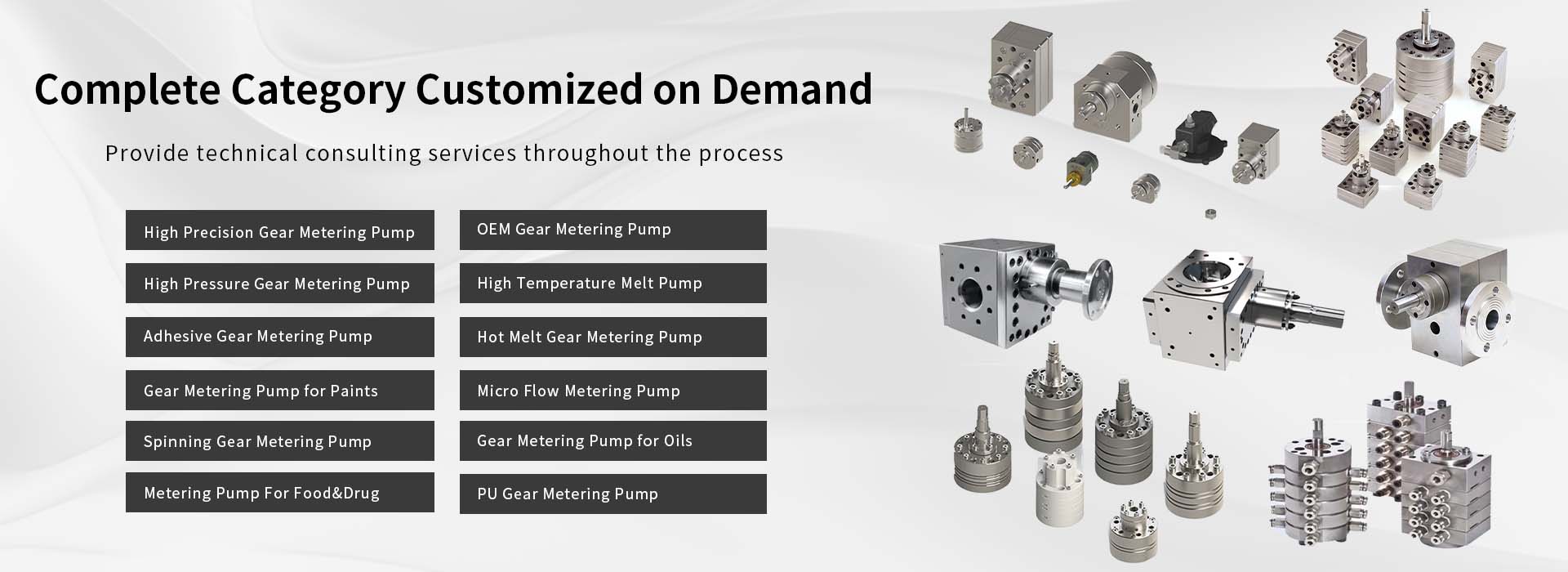
In modern automated industrial production, coating quality directly determines the final appearance and protective performance of products. As the “heart” of the coating system, Coating Equipment Gear Metering Pumps have a direct bearing on the stability, efficiency and quality of the entire production line through proper selection. Faced with a wide range of products on the market, how to accurately match the most suitable Coating Equipment Gear Metering Pump for high-demand coating equipment has become a key technical decision. This article sorts out several core consideration dimensions to help you make an informed choice.
Step 1: Clarify Process Medium Characteristics — The Foundation of Pump Selection
Pumps are designed to transfer media, so the physical and chemical properties of the medium are the primary basis for selection.
l Viscosity Range: This is the most critical parameter. Gear metering pumps excel at handling medium-to-high viscosity fluids, but different pump models have their optimal viscosity operating ranges. You need to determine the viscosity value of your coating, adhesive or resin at operating temperature (usually in cPs or mPa·s). Low-viscosity media may be compatible with a wider range of pump models, while ultra-high viscosity paste or slurry materials require heavy-duty gear pumps with special tooth profiles and higher drive torque.
l Corrosiveness and Composition: The chemical properties of the medium determine the selection of pump body materials. For coatings containing strong solvents or corrosive components, pumps and gears made of corrosion-resistant materials such as stainless steel (e.g., 304, 316L) or special alloys (e.g., Hastelloy) are a must. For highly abrasive fillers (e.g., those containing glass beads or metal powders), more wear-resistant materials like tool steel or ceramics should be considered to extend pump service life.
Step 2: Determine Flow Rate and Pressure Requirements — The Core of Pump Selection
Flow rate and pressure are the performance indicators of a pump, which must be precisely matched to your process requirements.
l Flow Rate (Displacement): Calculate the maximum, minimum and normal flow rates required by the production line (usually in L/min or cc/rev). The flow rate of a gear metering pump is proportional to its rotational speed. Therefore, during selection, ensure that the pump’s rated flow rate can cover your demand within the expected motor speed range, with a certain margin reserved. Avoid operating the pump at extreme low or high speeds for long periods.
l Outlet Pressure: Evaluate your system resistance, including pipeline length, pipe diameter, number of elbows, filter resistance, and back pressure from spray guns or coating heads. The rated working pressure of the selected pump must exceed the calculated maximum total system resistance, and its sealing structure and drive system must be able to withstand this pressure.
Step 3: Consider Precision and Stability — The Key of Pump Selection
If you have strict requirements for coating uniformity, thickness or two-component mixing ratio, the metering precision of the pump is critical.
l Metering Precision: High-precision gear metering pumps benefit from precision manufacturing processes (e.g., ground gears), minimal clearance between gears and pump cavity, and optimized tooth profile design (e.g., helical teeth reduce pulsation). When requesting quotes, pay attention to the accuracy and repeatability indicators provided by manufacturers.
l Flow Pulsation: Excessive flow pulsation can cause surface defects such as “orange peel” on coatings. Herringbone gear pumps or helical gear pumps outperform spur gear pumps in reducing pulsation. For ultra-high-demand applications, consider installing a pulsation damper at the outlet.
Step 4: Focus on Structure and Configuration — The Details of Pump Selection
The devil is in the details, and pump configuration directly affects its applicability and service life.
l Seal Type: This is one of the most critical trade-off considerations in selection. For applications that do not allow any leakage or involve highly volatile solvents, magnetic seals (seal-less design) are ideal. They use magnetic coupling for drive and completely eliminate leakage. For higher pressure or higher viscosity working conditions, mechanical seals may be more durable and cost-effective, but attention should be paid to their service life and potential risk of micro-leakage.
l Insulation/Cooling Function: If your medium needs to be insulated at a specific temperature (to maintain low viscosity) or requires cooling due to heat generation during pumping, it is necessary to select a pump body with a jacket. Heat transfer oil or cooling water can be circulated through the jacket to achieve precise temperature control of the medium.
l Drive Method: Decide whether to choose a fixed-speed motor or a stepless variable-speed motor with a frequency converter. Variable frequency control offers greater process flexibility, facilitating online flow adjustment and enabling more intelligent control.
Summary: Comprehensive Evaluation and Long-term Consideration
Selecting a suitable Coating Equipment Gear Metering Pump is a systematic trade-off process. It is by no means a simple parameter comparison, but requires comprehensive consideration of medium characteristics, process requirements, precision demands, equipment configuration, and total cost of ownership (including procurement cost, maintenance cost and service life). Conduct in-depth communication with experienced suppliers or engineers, and provide as detailed working condition information as possible to obtain the most targeted professional recommendations. The right selection will not only ensure the smooth operation of the current production line, but also lay a solid foundation for improving product quality, reducing operating costs and realizing process upgrades in the future.
Your email address cannot be published. Required fields are marked*
No comments