

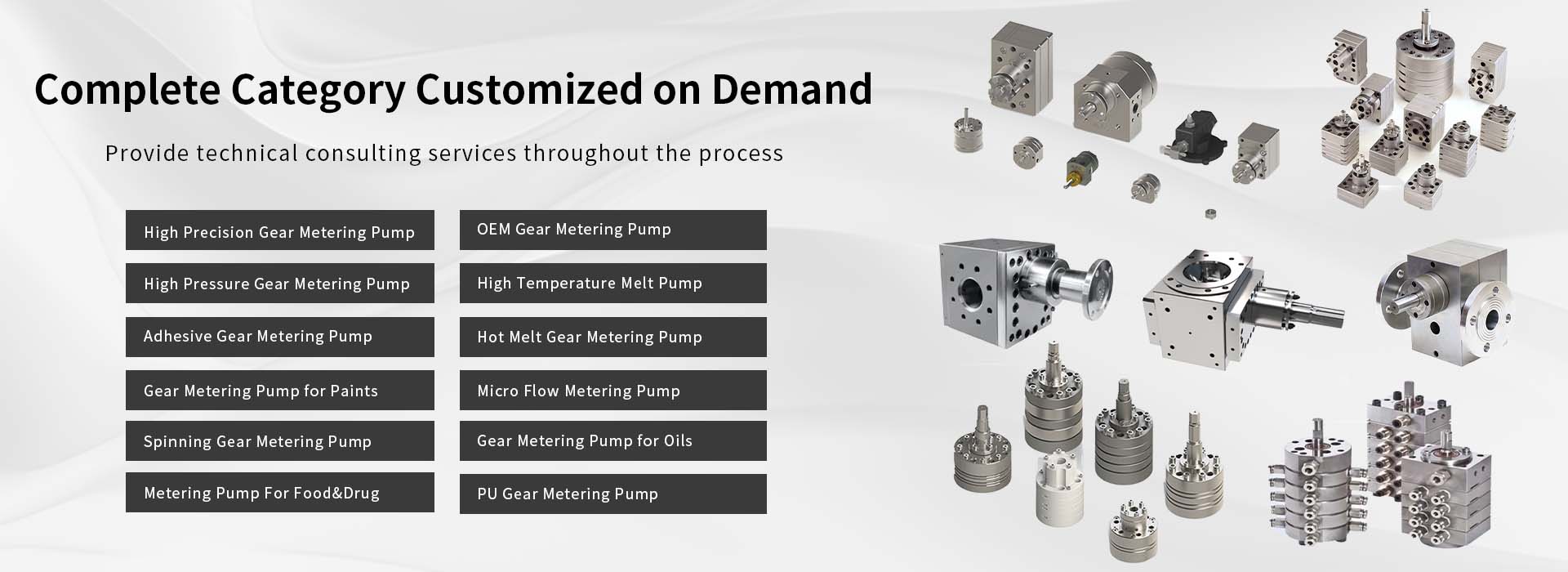
External gear pumps are a core category of positive displacement hydraulic pumps. Thanks to their unique structural design and excellent performance, they occupy an indispensable position in hydraulic transmission systems and are widely used in various industrial fields such as machinery, metallurgy, agriculture, and chemical engineering. Compared with similar products like internal gear pumps, vane pumps, and piston pumps, external gear pumps have distinct advantages in terms of structure, efficiency, cost, and adaptability. Their simple and reliable characteristics make them the preferred equipment for medium and low-pressure hydraulic systems. An in-depth analysis of their performance advantages is of great significance for rational type selection and improving system operation efficiency. The most prominent performance advantage of external gear pumps is their simple structure, compact size, and extremely low manufacturing and maintenance difficulty. Their core components only include a pair of intermeshing gears, pump body, pump cover, shaft, and seals. There are no complex cams, rotors, or valve distribution mechanisms. With a small number of parts and simple assembly processes, they greatly reduce the difficulty of manufacturing processes and production costs. Meanwhile, the simple structure makes the equipment compact in size and light in weight, facilitating installation on equipment with limited space. It can be flexibly adapted to the hydraulic systems of both small agricultural machinery and large construction machinery. In terms of maintenance, troubleshooting of external gear pumps is intuitive and easy to understand, and replacement of wearing parts is convenient. No professional high-precision maintenance equipment is required, and ordinary operators can complete daily inspections and repairs after simple training, effectively reducing equipment maintenance costs and downtime losses. Uniform and stable flow output with low pressure pulsation is another core performance advantage of external gear pumps. Their working principle is based on the periodic volume change of gear meshing chambers. The oil suction and discharge processes are continuous and synchronous. The volume of oil output per gear revolution is fixed, with no obvious flow fluctuation. Compared with the shortcomings of vane pumps that are susceptible to rotational speed and piston pumps with large pressure pulsation, external gear pumps exhibit excellent flow uniformity under medium-low speed and medium-low pressure working conditions. They can provide stable power output for hydraulic systems, effectively avoiding problems such as jamming and vibration of actuators caused by flow fluctuation. They are particularly suitable for conveying and control hydraulic systems with high requirements for operational stability. Strong adaptability and outstanding overload resistance enable them to adapt to complex and diverse working environments. External gear pumps have low requirements for hydraulic oil. They can be stably adapted to mineral oil, emulsion, and synthetic hydraulic oil without the need to specially select high-precision and high-cost special hydraulic oil, reducing operating costs. At the same time, their gears are made of high-strength materials, and after hardening treatment, they have excellent wear resistance and impact resistance. They can withstand a certain degree of overload and pressure impact without easily causing component damage or pump body failure. In addition, external gear pumps have a wide operating temperature range, capable of normal operation in environments from -20℃ to 120℃. They can adapt not only to indoor normal temperature working conditions but also to harsh industrial scenarios such as mines and metallurgy with high temperatures and heavy dust, with far superior adaptability compared to some similar hydraulic pumps. High cost-effectiveness and long service life are the highly competitive advantages of external gear pumps in the market. Due to their simple structure and high part commonality, their manufacturing cost is much lower than that of vane pumps and piston pumps. Moreover, with sufficient market supply, the equipment procurement cost is low. In terms of service life, under reasonable maintenance, the service life of external gear pumps can exceed 5000 hours. The wear rate of core components such as gears and shafts is slow, and the replacement cost of wearing parts is low, resulting in significant comprehensive cost advantages during long-term operation. For application scenarios with strict cost control such as small and medium-sized enterprises and agricultural machinery, the high cost-effectiveness of external gear pumps makes them the preferred equipment, which can not only meet production needs but also effectively control equipment investment and operating costs. In summary, relying on significant performance advantages such as simple structure, uniform flow, strong adaptability, high cost-effectiveness, and convenient maintenance, external gear pumps are widely used in medium and low-pressure hydraulic systems. Their performance advantages meet the actual needs of most industrial scenarios. They not only solve the pain points of similar hydraulic pumps such as high cost, difficult maintenance, and poor adaptability but also stably provide power output, ensuring the efficient and stable operation of hydraulic systems. With the continuous optimization of manufacturing processes, the performance of external gear pumps in terms of pressure rating and efficiency is constantly improving. Their application scope will be further expanded, continuously providing support for improving production efficiency in various industries.
Your email address cannot be published. Required fields are marked*
No comments