

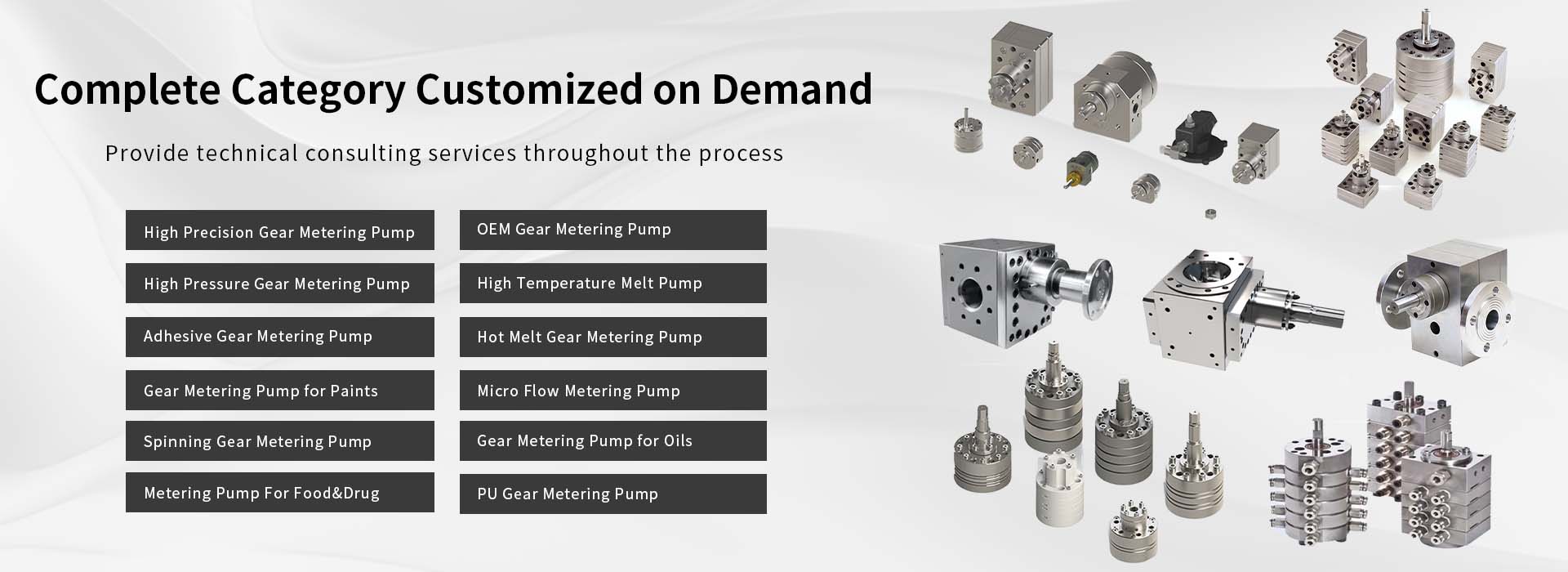
In hydraulic transmission and fluid conveying systems, external gear metering pumps and fixed-displacement pumps are two closely related concepts. Many industry practitioners often confuse the subordinate relationship between them, with the core question focusing on "whether an external gear metering pump is a fixed-displacement pump". The answer is clear and affirmative: an external gear metering pump is essentially an important category of fixed-displacement pumps. Its design principle, structural characteristics and operational performance fully conform to the core definition of fixed-displacement pumps, while also having the exclusive advantage of high metering accuracy. It is widely used in scenarios where strict control over fluid delivery volume is required. An in-depth analysis of the relationship between the two and the uniqueness of external gear metering pumps is of great practical significance for equipment selection, system debugging and efficient operation. To clarify the attribute of external gear metering pumps, it is first necessary to define the core definition and judgment criteria of fixed-displacement pumps. A fixed-displacement pump refers to a type of pump equipment that delivers a fixed volume of fluid per unit time under a given rotational speed and working pressure. Its core characteristic is "constant displacement", which means the pump's output flow is directly proportional only to the rotational speed and is not affected by fluctuations in outlet pressure (within the rated pressure range). The core function of a fixed-displacement pump is to provide a stable and predictable fluid delivery volume for the system, which distinguishes it from variable-displacement pumps that can adjust displacement according to working condition requirements. From the perspective of this core criterion, the working mechanism of external gear metering pumps fully complies with the definition of fixed-displacement pumps, making them a special type with metering functions in the fixed-displacement pump family. The structural design of external gear metering pumps determines their nature of quantitative delivery, which is also the core basis for their classification as fixed-displacement pumps. Similar to ordinary external gear pumps, the core components of an external gear metering pump consist of a pair of intermeshing gears, a precision pump body, pump cover, transmission shaft and seals, but its manufacturing precision is much higher than that of ordinary gear pumps. Its working principle is based on positive-displacement quantitative delivery: an electric motor drives the transmission shaft to rotate the driving gear, which then meshes with the driven gear to achieve synchronous reverse rotation. Multiple sealed meshing chambers are formed between the gears, the pump body and the pump cover. As the gears rotate, the meshing chambers gradually expand in the oil suction zone, creating a negative pressure to draw in fluid. As the gears continue to rotate, the meshing chambers move to the oil discharge zone and gradually contract, squeezing the fluid inside the chambers out at high pressure to complete one oil suction and discharge cycle. Since the tooth profile, module and number of teeth of the gears are fixed, the volume variation of the meshing chambers per gear revolution remains constant. Therefore, the fluid volume delivered per unit time is also fixed, changing only in direct proportion to the adjustment of rotational speed. This core characteristic fully conforms to the definition of fixed-displacement pumps as having "constant displacement". As a special category of fixed-displacement pumps, the key feature that distinguishes external gear metering pumps from ordinary fixed-displacement gear pumps is "metering accuracy". To meet the requirements of precise metering, external gear metering pumps have extremely high standards for part processing, assembly and debugging: the gears adopt high-precision involute tooth profiles and undergo precision grinding to ensure tooth surface fit and uniform clearance; the fit clearance between the pump body, pump cover and gears is controlled at the micron level to minimize leakage and avoid affecting metering accuracy; at the same time, they are equipped with precise rotational speed control devices and flow monitoring mechanisms, enabling accurate regulation and real-time monitoring of delivery volume. In practical applications, the quantitative characteristic of external gear metering pumps makes them widely used in scenarios requiring precise fluid delivery, such as chemical agent dosing in the chemical industry, fuel metering in the petroleum industry, raw material conveying in the food industry, and liquid medicine proportioning in the pharmaceutical industry. They not only exert the advantage of stable delivery of fixed-displacement pumps but also meet process requirements through high-precision metering. In addition, their advantages of simple structure, compact size and convenient maintenance are inherited from fixed-displacement gear pumps. Compared with piston-type fixed-displacement pumps, they are more suitable for precise metering scenarios with medium-low pressure and medium-small flow rates. In summary, there is no doubt that external gear metering pumps belong to fixed-displacement pumps. The core basis lies in their positive-displacement working principle based on gear meshing, which ensures a constant output flow per unit time and fully complies with the definition of fixed-displacement pumps. Meanwhile, on the basis of ordinary fixed-displacement gear pumps, they enhance metering accuracy, becoming special equipment with the dual functions of quantitative delivery and precise metering. They not only inherit the core advantages of fixed-displacement pumps but also expand the application scenarios of precise metering, playing an irreplaceable role in the field of fluid metering in industrial production.
Your email address cannot be published. Required fields are marked*
No comments