

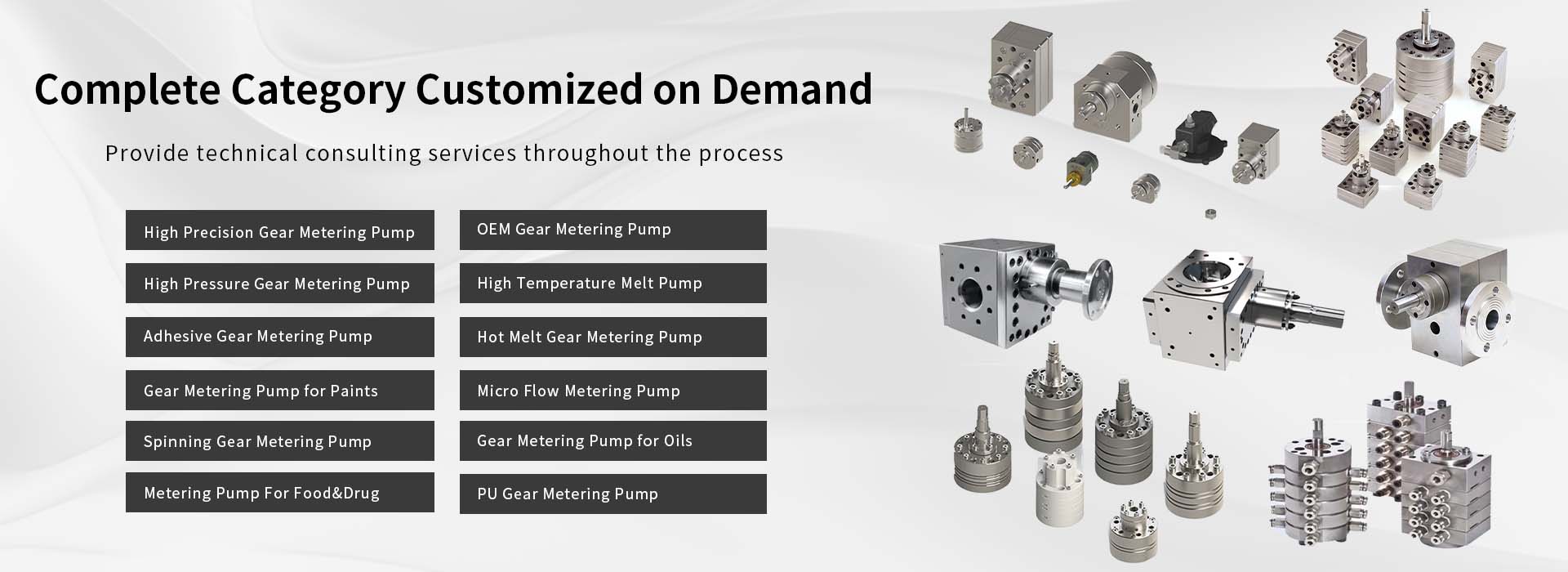
As a precision positive-displacement metering device, the external gear metering pump is widely used in industries with extremely high requirements for fluid metering accuracy, such as chemical engineering, pharmaceuticals, and food processing, thanks to its advantages of accurate fixed-quantity delivery and compact structure. Its core function is to realize the precise and fixed-quantity delivery of fluids. However, affected by factors such as manufacturing precision, operational standards, working condition adaptation, and improper maintenance, various problems are likely to occur. Among these, the three most prominent and impactful core issues are: metering accuracy deviation, pump body leakage, and abnormal gear wear. These three problems will not only lead to reduced equipment performance and shortened service life, but may also affect the stability of production processes, cause material waste, and even create potential safety hazards.
Metering accuracy deviation is the most core and common problem of external gear metering pumps, and it is also a key hidden danger that violates their core value of “metering”. It is mainly manifested in the inconsistency between the actual output flow rate and the set flow rate, with the deviation exceeding the rated range (usually an allowable deviation of ±0.5%~±1%), and the deviation is unstable. There are three core causes for this problem: first, insufficient structural precision. Gear tooth profile machining errors and excessively large fit clearances between gears and the pump body lead to fluid leakage exceeding the allowable range, especially axial leakage, which directly reduces the effective delivery volume; second, improper operation and working condition adaptation. Unstable motor speed, mismatch between medium viscosity and gear parameters, excessive resistance in the oil suction pipeline, or cavitation caused by air intake will all damage the stability of positive-displacement delivery and trigger accuracy deviation; third, delayed maintenance. Failure to replace worn gears and seals in a timely manner leads to increased fit clearances, or filter clogging causes medium impurities to enter, aggravating tooth surface wear and further expanding the accuracy deviation.
Pump body leakage is the second core problem of external gear metering pumps, which is mainly divided into two types: internal leakage and external leakage. Both types of leakage will affect equipment performance and production safety. Internal leakage refers to the leakage of fluid from high-pressure areas to low-pressure areas inside the pump body, mainly occurring between the gear end faces and the pump cover, as well as between the tooth crests and the pump body bore. Its causes are highly correlated with metering accuracy deviation, essentially resulting from excessively large fit clearances, aging seals, or gear wear. External leakage refers to the leakage of fluid from the joints between the pump body and pump cover, as well as between the transmission shaft and seals. The main causes include aging, damage or improper installation of seals, and loose pump body bolts, leading to poor fit of the sealing surfaces. Especially when conveying corrosive, flammable and explosive media, external leakage may also trigger potential safety hazards.
Abnormal gear wear is the third core problem of external gear metering pumps, and it is also an important inducing factor for the first two problems. It is mainly manifested as gear tooth surface wear, tooth crest wear, and tooth profile distortion, and in severe cases, gear jamming and tooth breakage may occur. There are four main causes for abnormal gear wear: first, substandard medium cleanliness. Solid impurities mixed in the medium will intensify abrasive wear on the tooth surfaces during gear meshing, which is the most main cause; second, insufficient lubrication. Low lubricating oil level, deteriorated oil quality, or failure to select suitable lubricating oil will increase friction during gear meshing, leading to adhesive wear; third, overloaded working conditions. Long-term operation under working conditions exceeding the rated pressure and speed results in uneven stress on the gears, causing intensified local wear; fourth, installation deviation. Inclined pump body installation and insufficient coaxiality of the transmission shaft lead to misalignment of gear meshing, triggering eccentric wear. In the long run, this will lead to tooth profile distortion and even tooth breakage.
In summary, the three core problems of external gear metering pumps (metering accuracy deviation, pump body leakage, and abnormal gear wear) do not exist in isolation, but are interrelated and mutually influential: abnormal gear wear will increase fit clearances, causing pump body leakage, which in turn leads to metering accuracy deviation; conversely, metering accuracy deviation may reflect leakage or wear problems, while improper operation and maintenance can induce all three problems simultaneously. Clarifying the manifestations and causes of the three core problems can provide a clear direction for equipment troubleshooting and daily maintenance, help industry practitioners avoid potential hazards in advance, reduce the failure rate, give full play to the accurate metering advantages of external gear metering pumps, and ensure the stability of production processes.
Your email address cannot be published. Required fields are marked*
No comments